
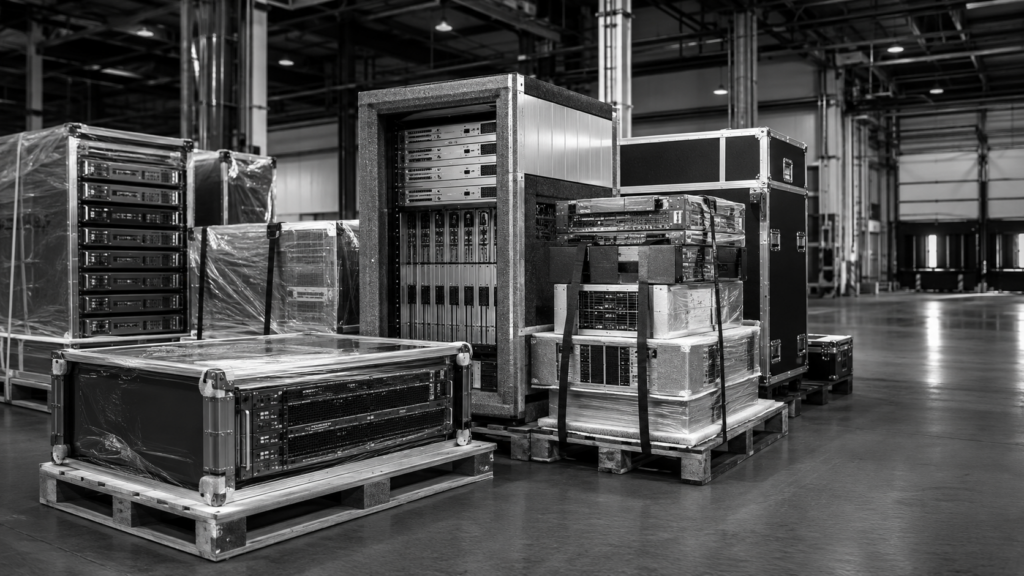
Buying enterprise technology internationally is only half of the procurement challenge.
The other half is getting it safely from the supplier to the destination.
Servers, network systems, telecommunications hardware and industrial equipment present logistics requirements that differ significantly from ordinary commercial goods. They may be expensive, fragile, configuration-specific, unusually heavy or subject to complex customs and export procedures.
A procurement project can therefore succeed commercially and technically while still failing operationally because logistics were treated as an afterthought.
For international technology procurement, logistics is part of the product.
Why Technology Logistics Is Different
Enterprise technology frequently combines high monetary value with physical sensitivity.
Servers and networking equipment can contain storage devices, circuit boards, power systems and precision connectors vulnerable to impact, static electricity, humidity or poor packaging.
Telecommunications infrastructure may include specialized modules whose value is disproportionate to their physical size.
Industrial equipment introduces different challenges, including weight, dimensions, specialized loading requirements and potentially complex documentation.
These characteristics require logistics planning that begins before equipment leaves the supplier.
The Procurement-to-Delivery Chain
A typical international technology transaction may involve:
Supplier → Inspection → Collection → Warehouse → Consolidation → Export Documentation → International Transport → Customs → Local Delivery
Every handoff introduces potential risk.
Professional logistics management aims to make those handoffs visible and controlled.
Supplier Collection
Technology procurement often involves multiple suppliers.
One vendor may provide servers, another networking equipment and another spare components.
Shipping each order independently can increase transportation costs and create unnecessary administrative complexity.
A consolidation warehouse provides an alternative.
Equipment can be collected from multiple suppliers, checked and combined into a coordinated shipment.
This creates advantages including:
- Lower shipping costs
- Fewer customs entries
- Improved shipment visibility
- Coordinated documentation
- Better packaging control
For international technology buyers, consolidation can therefore become a procurement tool rather than merely a transportation service.
Inspection Before Shipment
Discovering a procurement error after equipment has crossed international borders is expensive.
Pre-shipment inspection can verify essential information such as:
- Product identity
- Model number
- Quantity
- Physical condition
- Packaging condition
- Accessories
- Serial numbers
- Configuration where applicable
Inspection does not replace technical testing, but it creates an additional control point before international transportation begins.
Packaging Is Risk Management
Enterprise hardware should not be packaged like ordinary merchandise.
Proper packaging may require:
- Anti-static protection
- Shock absorption
- Moisture protection
- Reinforced cartons
- Palletization
- Equipment immobilization
- Protective crates
Industrial machinery may require custom wooden packaging or specialized loading arrangements.
The cost of professional packaging is typically small compared with the cost of damaged technology.
Choosing the Transportation Mode
There is no universally correct transportation method.
The decision depends on value, urgency, dimensions, weight and destination.
| Mode | Typical Advantage |
|---|---|
| Air Freight | Speed and high-value shipments |
| Road Freight | Regional flexibility |
| Sea Freight | Economical heavy or large shipments |
| Express Courier | Small urgent components |
| Multimodal | Complex international routes |
Critical spare parts may justify premium air transportation because downtime costs exceed freight cost.
Large industrial equipment may make sea transport economically necessary.
Logistics decisions should therefore reflect the business impact of delivery time.
Customs and Documentation
International technology shipments depend heavily on accurate documentation.
Incorrect product descriptions, quantities, values or classification can create delays and additional costs.
Depending on origin, destination and equipment type, documentation may include commercial invoices, packing lists, certificates of origin, transportation documents and other compliance information.
Complex technology supply chains benefit from preparing these requirements before shipment rather than resolving documentation problems at the border.
Logistics for Refurbished Equipment
Refurbished technology introduces additional considerations.
Equipment may originate from secondary inventories rather than manufacturer distribution centers. Multiple units may come from different sources and require consolidation before shipment.
Accurate equipment identification and condition documentation become especially important.
This creates a natural relationship between professional refurbishment and specialized logistics.
The value proposition is strongest when sourcing, technical verification, packaging and transportation operate as a connected process.
Supply Chain Resilience
Supply chain resilience is not simply having more suppliers.
It is having more ways to reach the required equipment.
An organization may source technology from different countries, consolidate it through regional warehouses and select transportation routes according to urgency and availability.
This flexibility becomes particularly valuable when conventional supply channels are disrupted.
A diversified sourcing and logistics network can help procurement teams respond to:
- Manufacturer shortages
- Long lead times
- Regional inventory constraints
- Transportation disruption
- Urgent replacement requirements
Logistics as Part of Total Cost of Ownership
The cheapest freight quotation is not necessarily the lowest-cost logistics option.
Poor logistics can create hidden expenses through:
- Equipment damage
- Delayed projects
- Customs penalties
- Storage charges
- Emergency replacement
- Production downtime
- Administrative overhead
Professional technology procurement therefore evaluates logistics according to total landed cost and operational risk rather than freight price alone.
Building a Better Technology Supply Chain
Organizations purchasing technology internationally can improve procurement outcomes by integrating sourcing and logistics planning.
Before placing an order, buyers should understand:
- Supplier location
- Equipment dimensions and weight
- Packaging requirements
- Export requirements
- Customs documentation
- Transportation alternatives
- Expected lead time
- Consolidation opportunities
- Final delivery requirements
This information allows procurement teams to evaluate the true cost and feasibility of a purchase before committing capital.
Conclusion
Technology does not create business value when it is sitting in the wrong warehouse, delayed at customs or damaged during transportation.
International procurement succeeds only when sourcing and logistics operate as a single coordinated process.
For enterprise IT, telecommunications and industrial equipment, specialized logistics provides the infrastructure connecting global supply with local operational requirements.
The result is not simply faster transportation.
It is more predictable procurement.
AYARAL Perspective
AYARAL combines international technology sourcing with warehousing, shipment consolidation, documentation support and global logistics for enterprise IT, telecommunications and industrial equipment.
This integrated approach allows customers to manage complex international procurement through a coordinated supply chain—from identifying equipment to final delivery.
Leave a Reply