
Executive Summary
Across every industry, organizations are being asked to achieve two objectives that often seem contradictory: reducing technology costs while advancing sustainability commitments.
Historically, these priorities were managed independently. Procurement teams focused on lowering acquisition costs, while sustainability initiatives concentrated on environmental responsibility.
Today, leading organizations understand that these goals can support one another.
Professional refurbishment has become one of the most effective ways to extend the lifecycle of enterprise technology while maintaining operational reliability and reducing total investment costs.
Rather than viewing refurbished equipment as a low-cost alternative, modern enterprises increasingly recognize refurbishment as a strategic component of technology lifecycle management.
By extending the useful life of servers, networking infrastructure, telecommunications platforms and industrial equipment, organizations reduce electronic waste, lower embodied carbon emissions and improve procurement flexibility.
This article explains how refurbishment contributes to financial efficiency, operational resilience and long-term sustainability while supporting responsible enterprise technology investments.
Introduction
Technology infrastructure represents one of the largest long-term investments for modern enterprises.
Servers, storage platforms, networking equipment, industrial automation systems and telecommunications infrastructure require continuous investment to support business growth and operational continuity.
At the same time, organizations are expected to reduce operational expenditure, improve sustainability performance and increase resilience against supply chain disruption.
These changing priorities have fundamentally transformed technology procurement.
Instead of replacing equipment solely because of age, organizations increasingly evaluate technology according to its remaining business value.
Professional refurbishment supports this strategy by restoring enterprise equipment to reliable operating condition through engineering processes that include diagnostics, testing, component replacement, firmware updates and quality assurance.
Unlike ordinary second-hand equipment, professionally refurbished systems are prepared for continued enterprise operation.
When performed correctly, refurbishment enables organizations to reduce capital expenditure while maintaining performance suitable for many production environments.
As global technology supply chains become increasingly complex, refurbishment has also become an important procurement strategy for reducing lead times and improving equipment availability.
The objective is no longer simply purchasing technology.
The objective is maximizing value throughout the entire technology lifecycle.
Understanding Professional Refurbishment
One of the most common misconceptions is that refurbished equipment is simply used equipment offered for resale.
Professional refurbishment is fundamentally different.
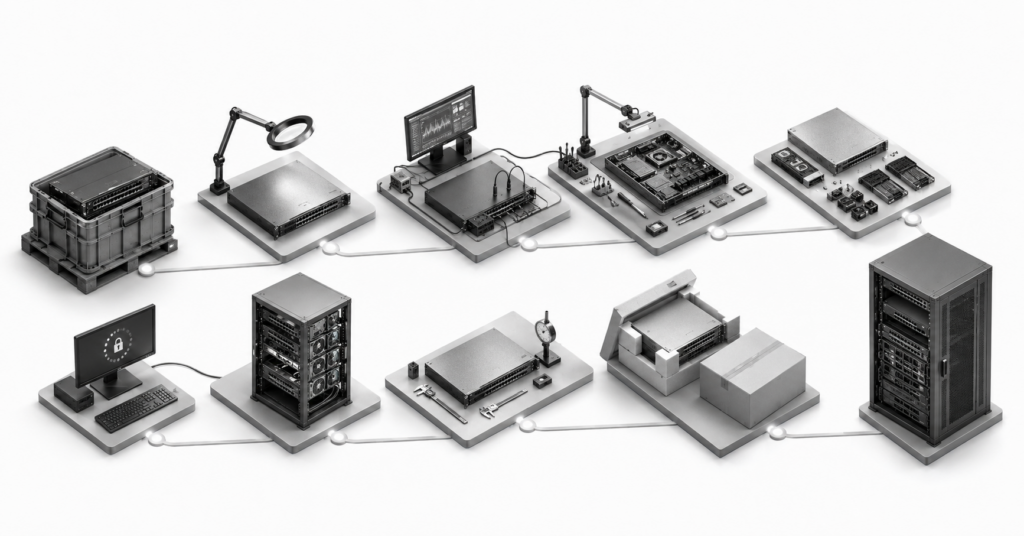
A refurbished enterprise product follows a documented engineering process before being returned to service.
Typical refurbishment activities include:
- Visual inspection
- Hardware diagnostics
- Functional testing
- Component replacement
- Firmware updates
- Cosmetic restoration
- Burn-in testing
- Final quality assurance
- Packaging and documentation
Each stage reduces operational risk while increasing confidence that the equipment can continue supporting enterprise workloads.
Professional refurbishment is therefore an engineering discipline—not simply a resale activity.
Why Enterprise Equipment Is Well Suited for Refurbishment
Enterprise technology differs significantly from consumer electronics.
Servers, storage systems, telecommunications platforms and industrial hardware are designed for continuous operation, modular maintenance and long service life.
Many enterprise products remain technically capable long after organizations replace them because of:
- Technology refresh policies
- Capacity upgrades
- Vendor support changes
- Data center modernization
- Mergers and acquisitions
In many cases, equipment is replaced for strategic reasons rather than technical failure.
Professional refurbishment allows this equipment to continue delivering business value through an additional lifecycle.
The Engineering Behind Refurbishment
Professional refurbishment follows standardized engineering procedures rather than cosmetic repair.
Typical activities include:
Hardware Diagnostics
Every subsystem is evaluated independently.
Examples include:
- CPU health
- Memory integrity
- RAID controllers
- Storage devices
- Power supplies
- Cooling systems
- Network interfaces
Diagnostic tools help identify hidden failures before equipment returns to production.
Component Replacement
Any component that does not satisfy engineering requirements is replaced.
Typical replacements include:
- Fans
- SSDs
- Hard drives
- Power supplies
- Memory modules
- Batteries
- Optical transceivers
- Cooling assemblies
Replacement components are selected according to enterprise compatibility and performance specifications.
Business Benefits
Technology investment decisions are no longer based solely on purchase price.
Modern enterprises evaluate every infrastructure investment according to long-term business value, operational resilience, procurement flexibility and sustainability objectives.
Within this broader framework, professional refurbishment has evolved from an alternative purchasing option into a strategic technology procurement model.
Organizations adopting lifecycle-based procurement strategies frequently discover that refurbished enterprise equipment delivers measurable operational and financial advantages while reducing environmental impact.
Looking Beyond Purchase Price
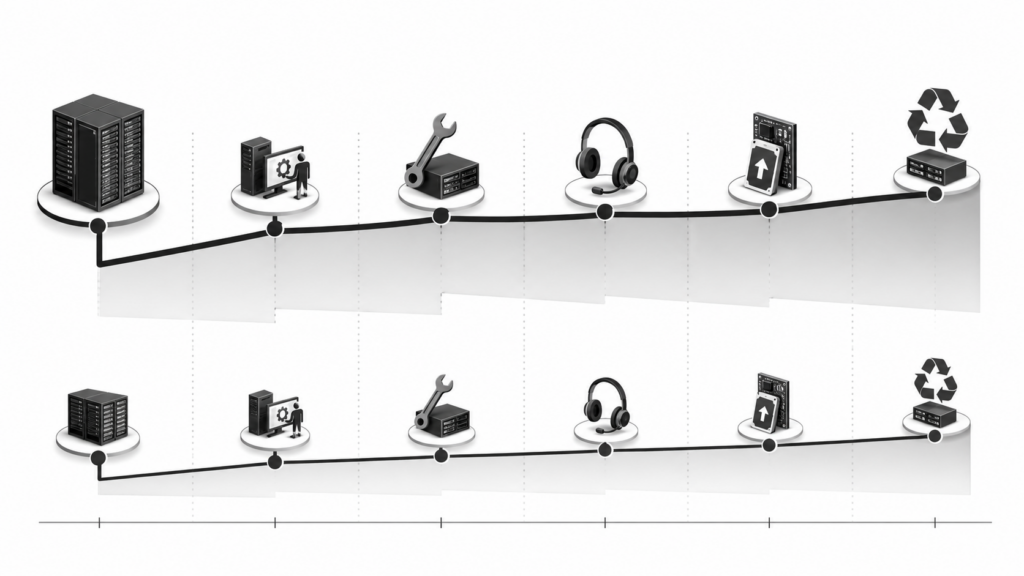
The purchase price of enterprise hardware represents only one part of its total lifetime cost.
Decision makers should also consider:
- Procurement lead time
- Deployment costs
- Operational maintenance
- Energy consumption
- Downtime risks
- Spare part availability
- Technical support
- End-of-life management
This broader financial perspective is commonly known as Total Cost of Ownership (TCO).
Evaluating procurement decisions through a TCO model provides a significantly more accurate understanding of long-term technology investment than comparing purchase prices alone.
Professionally refurbished enterprise equipment can substantially reduce acquisition costs while maintaining dependable performance for many enterprise workloads.
Understanding Total Cost of Ownership
Every technology investment includes multiple categories of cost throughout its operational lifecycle.
| Cost Category | Typical Business Impact |
|---|---|
| Acquisition | Initial capital investment |
| Logistics | Transportation and customs |
| Installation | Deployment resources |
| Maintenance | Ongoing operational support |
| Downtime | Business interruption |
| Energy | Operating costs |
| Replacement | Future capital investment |
| Disposal | End-of-life management |
Organizations that evaluate all of these categories typically make more informed procurement decisions than those focusing exclusively on acquisition cost.
Procurement Flexibility
Professional refurbishment offers organizations significantly greater procurement flexibility.
Instead of replacing entire infrastructure platforms, organizations can:
- Expand existing environments
- Maintain hardware compatibility
- Purchase identical hardware generations
- Extend infrastructure life
- Build economical spare inventory
- Reduce procurement lead times
These advantages are especially valuable in environments where system stability is more important than deploying the latest hardware generation.
Supply Chain Resilience
Global technology supply chains have become increasingly unpredictable.
Manufacturing delays, semiconductor shortages, transportation disruptions and geopolitical events have all affected equipment availability.
Professional refurbishment introduces an additional sourcing channel that helps organizations maintain operational continuity when new equipment cannot be delivered quickly.
Rather than replacing traditional procurement strategies, refurbishment complements them by increasing sourcing flexibility and reducing dependence on a single supply chain.
Financial Advantages
Organizations implementing lifecycle-based procurement strategies often achieve:
- Lower Capital Expenditure (CAPEX)
- Improved budget planning
- Better purchasing flexibility
- Higher asset utilization
- Reduced emergency procurement costs
- Improved inventory management
Although financial outcomes vary according to infrastructure size and procurement policies, refurbishment frequently enables organizations to optimize technology investment while preserving operational reliability.
Sustainability Creates Business Value
Environmental responsibility is increasingly becoming a competitive business advantage.
Customers, investors and regulators expect organizations to demonstrate measurable progress toward sustainability objectives.
Professional refurbishment directly supports these goals by:
- Extending equipment lifecycle
- Reducing electronic waste
- Lowering demand for newly manufactured hardware
- Conserving natural resources
- Supporting circular economy initiatives
- Reducing embodied carbon emissions
For many organizations, sustainability is no longer a separate initiative.
It has become an integral part of procurement strategy.
Real-World Enterprise Applications
Professional refurbishment provides value across a wide range of enterprise environments.
Data Centers
Increase computing capacity while maintaining compatibility with existing infrastructure.
Telecommunications Networks
Expand geographically distributed networks without introducing unnecessary hardware diversity.
Industrial Manufacturing
Replace failed equipment without redesigning operational environments.
Disaster Recovery
Build standby infrastructure using enterprise-grade equipment with optimized investment.
Spare Parts Inventory
Maintain replacement inventory economically while improving operational continuity.
Smart Procurement Means Smart Lifecycle Management
Successful technology procurement is no longer about purchasing the newest hardware.
It is about selecting the most appropriate technology for each business requirement.
Many organizations now combine new and professionally refurbished equipment within the same infrastructure.
Typical examples include:
| Infrastructure Area | Recommended Procurement Model |
|---|---|
| Mission-Critical Core Systems | New Equipment |
| Infrastructure Expansion | Refurbished Equipment |
| Disaster Recovery | Refurbished Equipment |
| Development Environments | Refurbished Equipment |
| Training Laboratories | Refurbished Equipment |
| Spare Inventory | Refurbished Equipment |
This hybrid approach enables organizations to balance operational performance, financial efficiency and sustainability objectives.
The benefits described above naturally lead to another important question:
How can organizations identify reliable refurbishment providers and minimize procurement risk?
The following section presents practical procurement guidelines, supplier evaluation criteria and frequently asked questions to support informed purchasing decisions.
Best Practices for Purchasing Refurbished Enterprise Equipment
Purchasing refurbished enterprise equipment should never be based solely on price.
A successful procurement strategy evaluates engineering quality, supplier capabilities, warranty coverage, documentation and long-term operational value.
Organizations following structured procurement practices significantly reduce purchasing risk while maximizing return on investment.
Enterprise Buyer’s Checklist
Before approving any purchase, verify the following:
- Refurbishment process is documented
- Hardware diagnostics have been completed
- Burn-in testing has been performed
- Firmware has been updated
- Warranty terms are clearly defined
- Testing reports are available
- Spare parts are accessible
- Logistics and delivery processes are documented
- Sustainability policies are transparent
- Technical support is available after delivery
This simple checklist helps organizations reduce procurement uncertainty while improving long-term operational reliability.
Frequently Asked Questions
What is the difference between refurbished and used enterprise equipment?
Used equipment is generally sold without comprehensive engineering inspection.
Professionally refurbished equipment has been tested, repaired where necessary, updated, cleaned and validated before returning to service.
Is refurbished enterprise hardware reliable?
Yes.
When supplied by an experienced refurbishment provider using documented engineering procedures, refurbished enterprise equipment can provide reliable performance for many production environments.
Which organizations benefit most?
Professional refurbishment is particularly valuable for:
- Enterprise IT departments
- Data centers
- Telecommunications operators
- Industrial manufacturers
- Financial institutions
- Government organizations
- Educational institutions
Does refurbishment support sustainability goals?
Absolutely.
Refurbishment extends equipment lifecycle, reduces electronic waste, lowers manufacturing demand and contributes directly to Circular Economy initiatives.
Should every enterprise system be refurbished?
No.
Mission-critical infrastructure may require newly manufactured equipment depending on workload and compliance requirements.
Many organizations successfully adopt a hybrid strategy by combining new equipment with professionally refurbished infrastructure where appropriate.
Conclusion
Technology procurement has evolved beyond choosing between new equipment and delaying investment.
Today’s organizations must balance operational performance, financial efficiency, supply chain resilience and environmental responsibility.
Professional refurbishment enables enterprises to extend the useful life of technology assets while reducing procurement costs and supporting sustainability objectives.
When refurbishment is supported by rigorous engineering processes, transparent documentation, comprehensive testing and reliable logistics, it becomes an integral part of a modern technology lifecycle strategy.
Organizations that embrace lifecycle thinking recognize that business value is created not only through acquisition, but also through responsible reuse, optimization and long-term asset management.
Refurbishment is therefore more than extending hardware life.
It is about extending business value.
Why Choose AYARAL
AYARAL specializes in sourcing, professional refurbishment and international logistics for enterprise technology, telecommunications and industrial equipment.
Our mission is to help organizations obtain reliable technology solutions while improving procurement efficiency and supporting long-term sustainability.
Whether you are expanding infrastructure, replacing legacy hardware or optimizing technology investment, our experienced team can support every stage of the procurement lifecycle.
Explore More
Visit our website to learn more about our solutions:
Explore our services in:
- Enterprise IT Equipment
- Refurbished Technology
- Telecommunications Infrastructure
- Industrial Machinery
- Global Logistics Solutions
Continue Reading
You may also be interested in:
- New vs. Refurbished Network Equipment: Which Is the Better Investment?
- Enterprise IT Procurement Best Practices
- Understanding Technology Lifecycle Management
- Circular Economy in Enterprise Technology
- Global Logistics for High-Value Technology Equipment
Last Updated: August 2026
Published by AYARAL Knowledge Center
Leave a Reply