
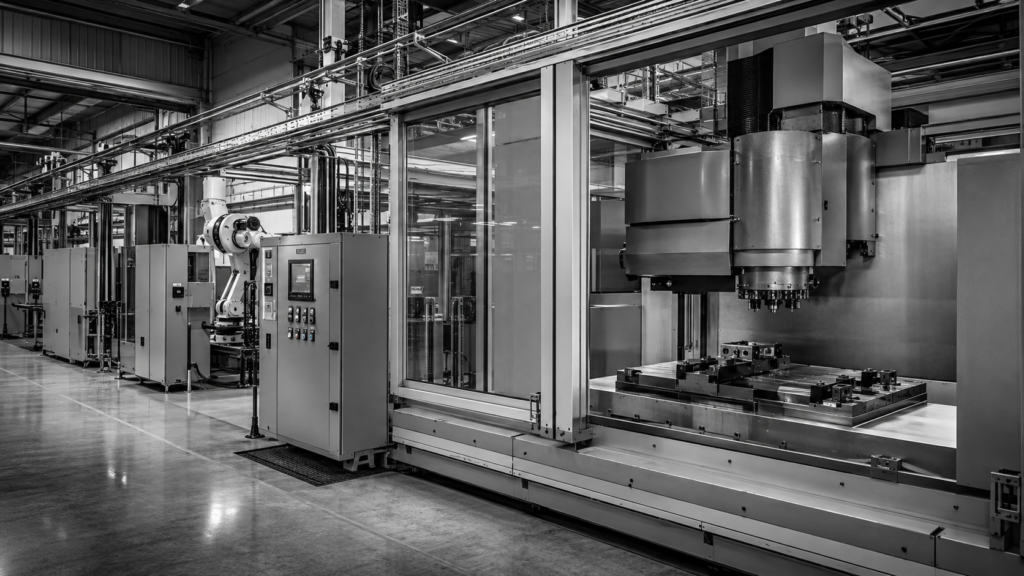
Industrial facilities operate on a fundamentally different technology cycle from most office and consumer environments. A production line, control system, packaging machine or specialized industrial platform may remain productive for ten, twenty or even thirty years.
The equipment itself may continue performing reliably long after its original manufacturer introduces a newer generation.
For manufacturers, this creates an important distinction between technological age and economic usefulness.
Replacing an established industrial system simply because a newer version exists can introduce substantial costs that extend far beyond the purchase price of the replacement equipment. Installation, integration, production interruption, employee training, software changes and requalification can make modernization considerably more complex than the initial procurement decision suggests.
This is why leading industrial organizations increasingly manage equipment through a lifecycle strategy.
The Economics of Installed Industrial Assets
Industrial equipment creates value through production.
Once machinery has been installed, integrated into a production environment and incorporated into operational processes, the organization has invested significantly more than the original purchase price.
That investment may include engineering, installation, configuration, tooling, employee training, maintenance procedures and integration with surrounding systems.
Replacing the equipment can therefore mean replacing part of this accumulated operational knowledge as well.
A lifecycle approach evaluates whether existing equipment can continue delivering acceptable productivity, reliability and safety before replacement is considered.
Why Industrial Equipment Remains in Service for So Long
Industrial systems are frequently engineered for long operating lives.
Many incorporate modular components that can be repaired or replaced individually.
This makes continued operation technically feasible even when certain parts begin to fail.
Common reasons for maintaining established equipment include:
- Proven operational reliability
- High replacement cost
- Production-line integration
- Specialized tooling
- Operator familiarity
- Regulatory qualification
- Limited modernization benefit
- Availability of replacement components
The challenge begins when the machinery remains valuable but its supporting components become difficult to obtain.
The Obsolescence Problem
Industrial obsolescence rarely occurs at the level of an entire machine simultaneously.
A production system may remain mechanically sound while a control board, drive, power module, interface card or specialized electronic component reaches end-of-life.
Manufacturers may discontinue these components as newer product generations enter the market.
This creates a procurement mismatch: the industrial asset remains economically useful while its supply chain begins disappearing.
Organizations without an obsolescence strategy often discover this problem only after a critical component fails.
At that point, procurement becomes urgent—and expensive.
Spare Parts as Operational Insurance
Critical spare-parts inventory should be viewed as a component of business continuity.
Industrial organizations can classify components according to four factors:
| Factor | Key Question |
|---|---|
| Criticality | Would failure stop production? |
| Availability | Can the component still be sourced easily? |
| Lead Time | How long would replacement take? |
| Substitutability | Can another component perform the same function? |
Components that are highly critical, difficult to source and impossible to substitute deserve particular attention.
Maintaining strategic inventory for these components can dramatically reduce the financial impact of unexpected failures.
Professional Refurbishment in Industrial Environments
Professional refurbishment provides another lifecycle option.
Equipment or components removed from service can undergo inspection, diagnostics, repair, replacement of defective elements, cleaning, functional testing and quality assurance before returning to operation.
Depending on the equipment category, refurbishment can provide organizations with:
- Compatible replacement components
- Economical backup equipment
- Extended machinery life
- Reduced emergency procurement
- Greater modernization flexibility
The objective is not to keep obsolete machinery operating indefinitely.
It is to avoid replacing productive assets prematurely.
Repair, Refurbish or Replace?
Every asset requires an individual decision.
A useful framework considers operational risk and economic value together.
| Situation | Potential Strategy |
|---|---|
| Reliable equipment with available parts | Continue operation |
| Reliable equipment with scarce parts | Build strategic spare inventory |
| Repairable component failure | Repair or refurbish |
| Capacity limitation | Upgrade or expand |
| Increasing failure frequency | Evaluate modernization |
| Safety or compliance limitation | Replace |
| Major productivity advantage from new technology | Modernize |
This framework prevents equipment age from becoming the only replacement criterion.
The Hidden Cost of Modernization
Modernization can create substantial business value, particularly when new technology improves productivity, energy efficiency, quality or automation.
But the complete cost should be understood.
Industrial replacement projects may involve:
- New equipment acquisition
- International transportation
- Customs and import processes
- Site preparation
- Installation
- Production shutdown
- Integration
- Software migration
- Testing
- Operator training
- Spare-parts inventory
- Certification or qualification
The economically correct decision is therefore not necessarily the machine with the lowest purchase price.
It is the strategy that produces the strongest lifecycle value.
Global Sourcing and Hard-to-Find Equipment
Industrial equipment supply chains are increasingly international.
A discontinued component unavailable through the original local distribution channel may still exist in another market, warehouse or specialized inventory.
Accessing these sources requires more than internet search.
Industrial procurement often demands precise identification of manufacturer, model, revision, configuration and compatibility.
International sourcing may additionally require supplier verification, export documentation, customs expertise and specialized transportation.
This combination of technical sourcing and logistics becomes particularly important for legacy industrial infrastructure.
Sustainability Through Asset Life Extension
Industrial machinery contains significant quantities of metals, electronics and engineered materials. Manufacturing replacement equipment also requires energy, raw materials and global transportation.
Extending the productive life of technically viable machinery can therefore reduce both capital consumption and environmental impact.
The principle is straightforward:
The most sustainable replacement can sometimes be the replacement that does not yet need to happen.
This does not mean avoiding modernization. It means modernizing when there is a genuine operational or economic reason to do so.
Building an Industrial Lifecycle Strategy
A practical lifecycle program begins with an accurate asset register.
Organizations should identify critical machinery and document:
- Manufacturer
- Model
- Installation date
- Configuration
- Critical components
- Maintenance history
- Spare-parts availability
- Manufacturer support status
- Potential replacement alternatives
The organization can then identify assets exposed to obsolescence risk before failures occur.
Procurement teams gain time to locate alternative suppliers, acquire strategic inventory or plan modernization under controlled conditions.
That time has significant economic value.
Conclusion
Industrial equipment should not be replaced according to calendar age alone.
A machine that remains safe, reliable and economically productive continues to represent a valuable business asset.
Lifecycle management provides manufacturers with a structured method for deciding when to maintain, repair, refurbish, upgrade or replace equipment.
Combined with proactive spare-parts planning and global sourcing capabilities, this approach reduces unplanned downtime and allows modernization investment to occur when it creates genuine business value.
The goal is neither to preserve old equipment indefinitely nor to pursue constant replacement.
It is to keep industrial assets productive for exactly as long as they continue creating value.
AYARAL Perspective
AYARAL supports industrial organizations with specialized equipment sourcing, hard-to-find components, professionally refurbished technology and international logistics.
For organizations maintaining established production environments, access to compatible equipment and critical spare parts can provide the operational flexibility required to plan modernization rather than react to failure.
Leave a Reply